Menu This site does not store any personal or financial data
The Fell Pony Society
Patron: His Majesty King Charles III
Registered Charity, Number 1104945.
The Fell Pony Society is a Company Limited by Guarantee 3233346.
About Fell Ponies
Early History | The Fell Pony Today | Description of the Fell Pony | Scale of Points
Early History
Translations /
Translated summaries: German
| French
| Dutch
| Danish
| Czech
NB:
The translations are updated by volunteers and are not guaranteed to be the most recent versions. They should be read in conjunction with the documents in English.
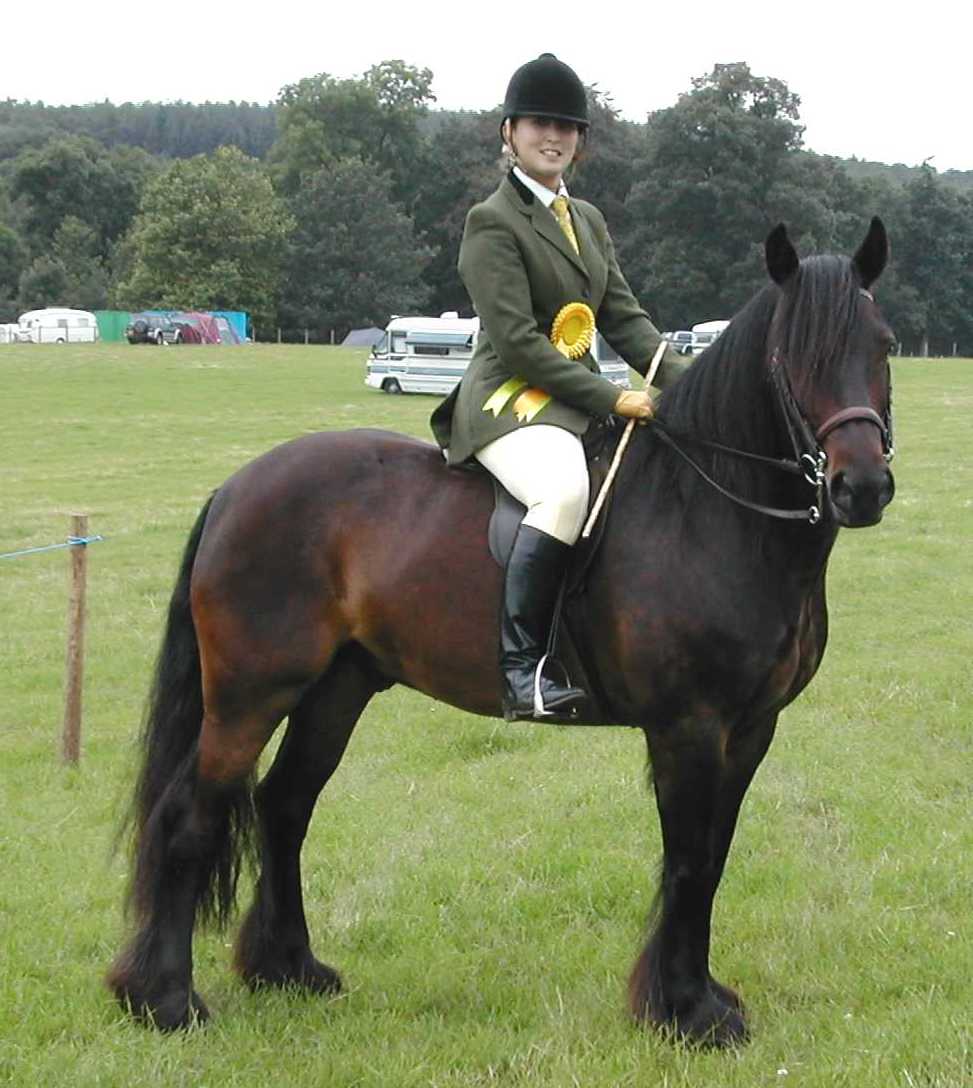 Fell ponies are native to the North of England, and
are mostly found in Cumbria, in the old counties of Cumberland and
Westmorland, where probably they roamed from pre-historic times. By the
Iron Age, equines were in relatively common use throughout Britain1 and averaged 12.1 hh in height; they
resembled the modern Exmoor breed in terms of overall build. By the
later part of the Roman occupation, somewhat later than the improvements
in other domestic species, the average height of British ponies had
increased to around 13 hh.2
Fell ponies are native to the North of England, and
are mostly found in Cumbria, in the old counties of Cumberland and
Westmorland, where probably they roamed from pre-historic times. By the
Iron Age, equines were in relatively common use throughout Britain1 and averaged 12.1 hh in height; they
resembled the modern Exmoor breed in terms of overall build. By the
later part of the Roman occupation, somewhat later than the improvements
in other domestic species, the average height of British ponies had
increased to around 13 hh.2
The Vikings used ponies to plough and pull sledges as well as for riding and pack work. The animals in use were kept handy in the villages, and the breeding stock lived out on the fell. From the 11th and 12th centuries ponies were being used for longer distance pack work carrying loads of fleeces, woollen goods, foodstuff such as cheeses, meat, fish and preserves, and local metal ores. They were used for shepherding and to hunt wolves that might attack the flocks on the sheepwalks.3
By the 13th century there was a brisk trade in wool to Belgium, and ponies or "capuls" were used to transport merchandise all around the country. The Fell type would have been particularly good for this purpose, being strong, a fast and steady walker and small enough to be easily loaded.4 Pack trains were well organised and made regular journeys. For instance, in the winter of 1492-93, 11 Kendal traders made a total of 14 journeys to Southampton with pack horses carrying loads of cloth. From the end of the Middle Ages to the 18th century, pack-horses continued to transport imported goods.
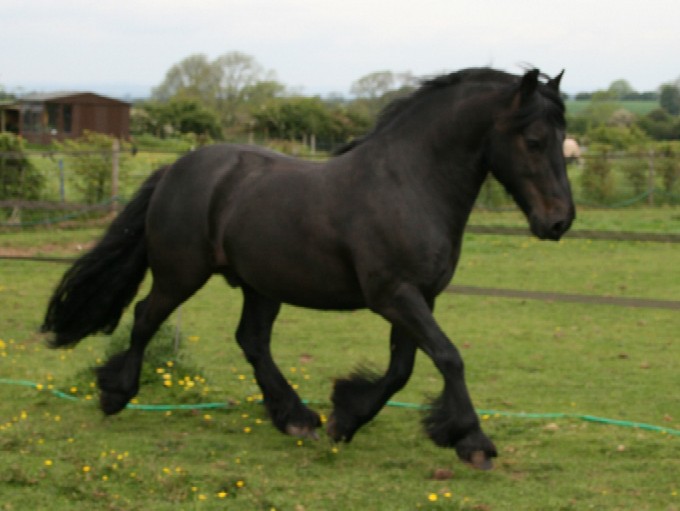 Fell Ponies, known
locally as 'galloways', were also used for the Cumberland sport of
trotting races. Modern Fell ponies are renowned for their ground
covering trot. 5
Fell Ponies, known
locally as 'galloways', were also used for the Cumberland sport of
trotting races. Modern Fell ponies are renowned for their ground
covering trot. 5
As industry developed, ponies were needed to transport copper, iron and lead ores from mines in the north-west of England to the smelting works. They also carried iron and lead long distances across country to Newcastle, returning with coal. Fell ponies were used by big Northeastern collieries such as Ashington until well into the 20th century. They were used underground, where the mine's seam height allowed, and above ground for moving machinery and also hauling dairy produce to town from the colliery farms overlying the pits.6 When canals and railways became the main means of transport, pack-pony trains and pony-based postal services remained a lifeline for remote communities.
In The Westmorland Gazette in 1853, a report about Dent Horse Fair referred to "fell ponies" (with a small "f") being sold. In 1856 Ireby District Agricultural Show held a show class for "the best Brood Pony direct from the fell", and there were 9 entries for the 15 shilling prize.
In 1861 a show class was held for "the best fell pony of any age" at Orton Agricultural Exhibition. A special prize was offered at Dufton Show in 1885 for any "fell-gone" pony with foal at foot (ie, to have lived on the fell and borne and reared a foal there). Prizes for various classes of Fell ponies were offered at Hesket New Market for the first time in 1890.7
Pony breeders had begun to record pedigrees in the second half of the 19th century, and the first Fell ponies were registered in the Polo and Riding Pony Stud Book in 1898.
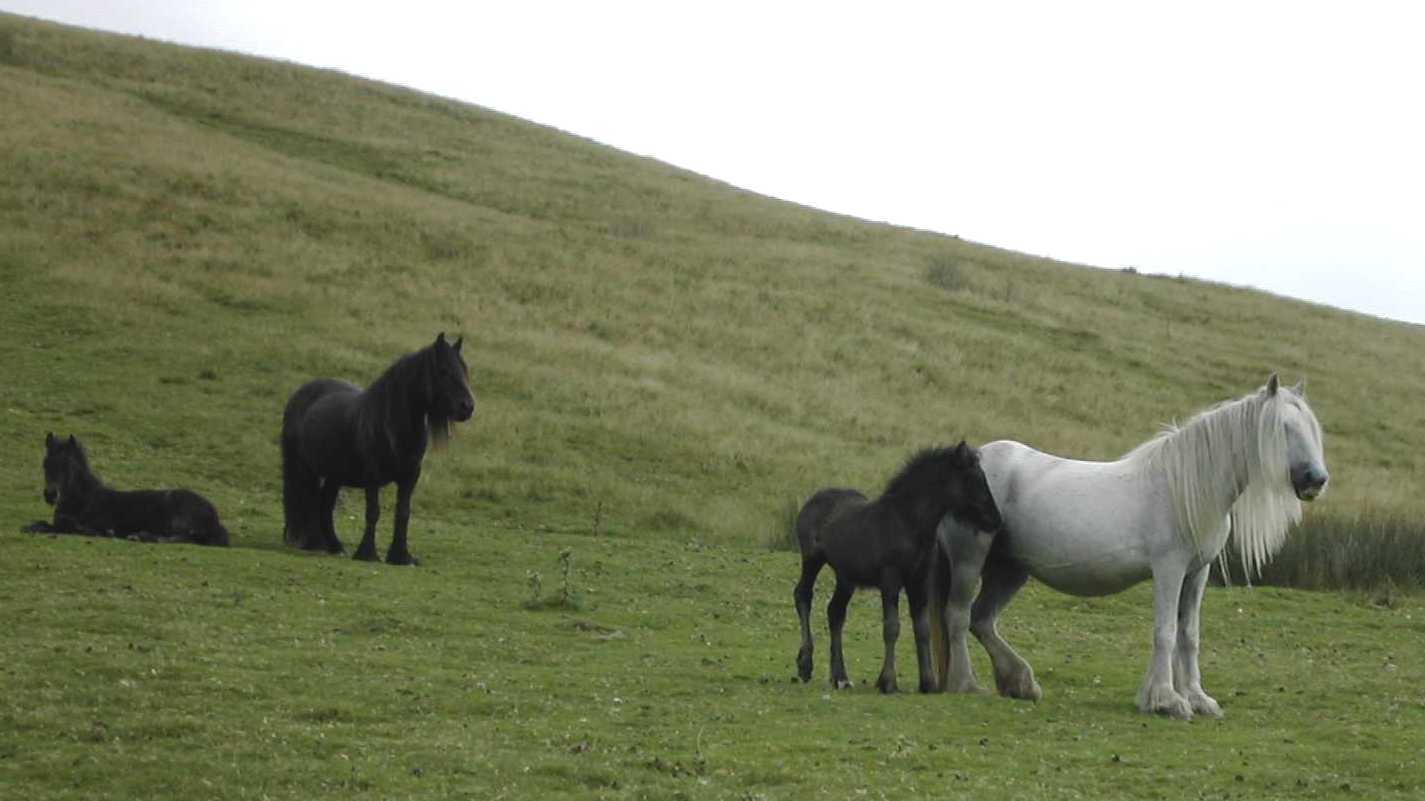 In 1922 the Fell Pony Society was set
up in its present form, not to "improve" but to "keep pure the old breed
of pony" in the face of cross breeding to produce farm horses and showy
road animals such as the Wilson pony. Bay and brown ponies were very
common at that time. It was not until the second half of the 20th
century that black became the predominant colour, followed by brown,
bay, and grey. White markings, in the form of stars and small amounts of
white on the hind pasterns, have remained fairly constant over the
decades. More than half the breed population has no white markings.
In 1922 the Fell Pony Society was set
up in its present form, not to "improve" but to "keep pure the old breed
of pony" in the face of cross breeding to produce farm horses and showy
road animals such as the Wilson pony. Bay and brown ponies were very
common at that time. It was not until the second half of the 20th
century that black became the predominant colour, followed by brown,
bay, and grey. White markings, in the form of stars and small amounts of
white on the hind pasterns, have remained fairly constant over the
decades. More than half the breed population has no white markings.
The affluent 1950's saw the rising popularity of riding for pleasure, a pursuit that has guaranteed the future of many native breeds. The number of ponies being registered with the Fell Pony Society has risen steadily, with foal registrations annually exceeding 400 in the first decade of the 21st century.
1. Bendrey, 2010, in Extinctions and Invasions:
A Social History of British Fauna
2. Johnstone, 2004, PhD Thesis: A Biometric
Study of Equids in the Roman World
3. Richardson, 1990, The Fell Pony
4. Richardson, 1990, The Fell Pony
5. FP Museum
6. Charlton, 1952, A Lifetime with Ponies
7. FP
Museum
Updated March 2019
The Fell Pony Today
The Fell is an ideal all-round family pony suitable for both adults and children. As a hack and general riding pony, the Fell's fast walk and easy paces make it a pleasant and comfortable ride, and its sure footedness ensures a safe passage over the roughest country. The Riding for the Disabled movement employs a number as mounts. It is possible to ride a Fell pony through places where other lighter bred ponies would come to grief and Fells seem to have a sixth sense which alerts them to possible danger. They appear to know which is the soundest track through soft marshy ground or the safest descent of a rocky hillside.
 To test these
qualities the Fell Pony Society holds an annual performance trial where
the course comprises a varied range of difficult terrain including steep
and twisting hills, boggy ground, a watercrossing and several natural
hazards such as fallen logs and the like. Fell Ponies are generally
creditable jumpers, particularly across country, being both agile and
clever on their feet. Their abilities are well up to working hunter pony
competitions and Pony Club events.
To test these
qualities the Fell Pony Society holds an annual performance trial where
the course comprises a varied range of difficult terrain including steep
and twisting hills, boggy ground, a watercrossing and several natural
hazards such as fallen logs and the like. Fell Ponies are generally
creditable jumpers, particularly across country, being both agile and
clever on their feet. Their abilities are well up to working hunter pony
competitions and Pony Club events.
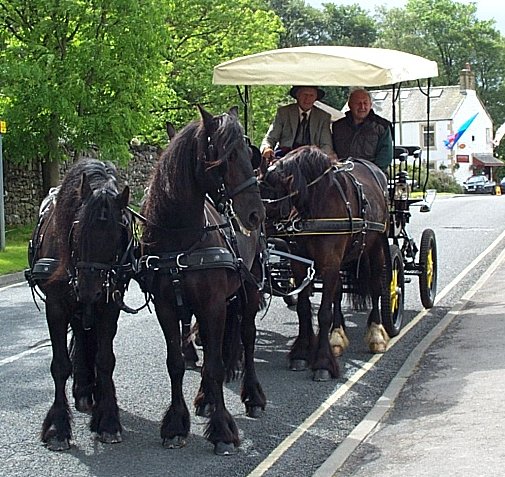 The rediscovery of
Driving as a recreational sport has given the Fell pony the means of
continuing in a job which it has traditionally done for centuries. They
are well suited to this work, having great stamina and soundness. The
fact that the Fell Ponies breed very true to type makes it easy to find
matched pairs.
The rediscovery of
Driving as a recreational sport has given the Fell pony the means of
continuing in a job which it has traditionally done for centuries. They
are well suited to this work, having great stamina and soundness. The
fact that the Fell Ponies breed very true to type makes it easy to find
matched pairs.
Fells take part in endurance riding and Cumbrian trotting races. They perform light forestry and farm work such as shepherding, and carry tourists on pony treks. They transport equipment to help repair walking routes. A few Fell Ponies are still used in Scotland carrying the stags and grouse panniers down from the moors. Some of HM The Queen's ponies are sometimes used for this purpose at Balmoral while others are used for both riding and driving by the Royal Family. In the 21st C Fells have become popular and successful in dressage and Trec competitions. Large numbers of Fell Ponies are used in riding and trekking stables throughout the country because of their steady temperaments and useful size.
All these attributes make the Fell pony an all round versatile family pony.
Description of the Fell Pony (updated 2019)
Translations: See top of page These translations were correct to 2018 and should be read in conjunction with the most recent English version, given here.
|
HEIGHT: |
Not exceeding 14 hands (142.2 cms). |
|
COLOUR & |
Black, brown, bay and grey. Chestnuts, piebalds and skewbalds
will be registered in |
|
HEAD: |
Small, well chiselled in outline, well set on, forehead broad, tapering to nose. |
|
NOSTRILS: |
Large and expanding. |
|
EYES: |
Prominent, bright, mild and intelligent. |
|
EARS: |
Neatly set, well formed and small. |
|
THROAT & JAW: |
Fine, showing no signs of throatiness nor coarseness. |
|
NECK: |
Of proportionate length, giving good length of rein, strong and not too heavy, moderate crest in case of stallion. |
|
SHOULDERS: |
Most important, well laid back and sloping, not too fine at withers, nor loaded at the points - a good long shoulder blade, muscles well developed. |
|
CARCASE: |
Good strong back of good outline, muscular loins, deep carcase, thick through heart, round ribbed from shoulders to flank, short and well coupled, hind quarters square and strong with tail well set on. |
|
FEET, LEGS AND JOINTS: |
Feet of good size, round and well formed, open at heels with the characteristic blue horn, fair sloping pasterns not too long, forelegs should be straight, well placed not tied at elbows, big well formed knees, short cannon bone, plenty of good flat bone below knee (eight inches at least), great muscularity of arm. |
|
HIND LEGS: |
Good thighs and second thighs, very muscular, hocks well let down and clean cut, plenty of bone below joint, hocks should not be sickle nor cow-hocked. |
|
MANE, TAIL AND FEATHER: |
Plenty of fine hair at heels (coarse hair objectionable), all the fine hair except that at point of heel may be cast in summer. Mane and tail are left to grow long. |
|
ACTION: |
Walk, smart and true. Trot well balanced all round, with good knee and hock action, going well from the shoulder and flexing the hocks, not going too wide nor near behind. Should show great pace and endurance, bringing the hind legs well under the body when going. |
|
GENERAL CHARACTERISTICS AND BREED TYPE: |
The Fell Pony should be constitutionally as hard as iron and show good pony characteristics with the unmistakable appearance of hardiness peculiar to mountain ponies, and at the same time, have a lively and alert appearance and great bone. Description updated by vote at AGM 2 April 2022 |
Type and Conformation - video
Please look for the Educational Video "Type and Conformation" created for the Society in 2022 by Tom Lloyd. This is part of the Society's educational activities as a charity, in celebration of our 100th year. It is available to purchase from the Society, £15 & P&P. You can also watch it online on Tom's Vimeo account or his Facebook page .
Scale of Points
Translations: See top of page
| Height and colour | 5 |
| Head, nostrils, eyes, ears, throat/jaw and neck |
10 |
| Shoulders | 15 |
| Carcase | 20 |
| Feet, legs and joints and hind legs |
25 |
| Action | 25 |
| General characteristics and breed type | 100 |
The material on this page may be freely quoted in part or whole, but should not be altered. The source should be acknowledged as "copyright of the Fell Pony Society" and the URL of this page should be given, http://www.fellponysociety.org/about_breed.htm
Advertising Comparisons
The Fell Pony Society has frequently been made aware, by FPS members in England, Europe and USA, of advertisements containing the term "Mini Friesian" with reference to Fell ponies. Our Overseas Branches also tell us that they have to correct the use of this term on a regular basis, when exhibiting Fell ponies to the general public. To make such comparisons deliberately in any advertisement is misleading both about the Fell pony and about any other breed that is compared to it.
The Fell Pony Society wishes to state that it strongly disapproves of the use of comparisons with other breeds to describe, promote or advertise the Fell. A Fell pony is a Fell pony, a strong, hardy, versatile, purebred English working pony, who should not be described as a mini version of any other breed.
For a longer discussion of the historical arguments about the Friesian comparison, please see the Fell Pony Museum web site, http://www.fellponymuseum.org.uk/fells/rom_dark/friesian.htm.